.webp)

Last month, Early Childhood Education and Development (ECED) students ventured out of the classroom and over the Atlantic. Led by faculty members Henna Viertio, Lori Gray Toma, and Tyra Richmond, the students travelled from Calgary to Italy for an immersive study abroad experience focused on global approaches to early childhood education.
This spring, learning took Early Childhood Education and Development (ECED) students out of the classroom and across the Atlantic.
From April 19 to 26, a group of 10 fourth-term Early Childhood Education and Development Diploma students, led by faculty members Henna Viertio, Lori Gray Toma, and Tyra Richmond from the School of Community Studies, travelled from Calgary to Italy for an immersive study abroad experience focused on global approaches to early childhood education.
The journey took students to Urbania, Reggio Emilia and Florence, offering a rare opportunity to see internationally respected early learning philosophies in action.
Designed for students in the final term of their program, the experience was both a capstone academic opportunity and a special time for personal and professional reflection, challenging students to think deeply about who they are becoming as early childhood educators.
.webp)
Where the Philosophy Lives
A major focus of the trip was the Finnish Organizational Model (“MOF”), an approach to early childhood education which centers on children’s well-being, autonomy, creativity and ability to learn through lived experience.
“The Finnish Organizational Model really focuses on restoring children’s enjoyment in learning,” explains Henna Viertio, one of the faculty leaders on the trip, and a native of Finland. “Well-being is the foundational element, because any kind of learning only really happens when children feel happy and well.”
In Urbania, the students attended three mornings at local preschools, where the MOF approach is actively implemented with children aged three to six. Supported by local interpreters, students observed classroom dynamics while engaging directly with children and learning from Italian educators.
“The students were very much immersed,” Henna shares. “They interacted with the children, learned from the teachers, and experienced the pedagogy firsthand. It was a very powerful learning experience.”
For students, seeing these philosophies in action brought their coursework to life.
“The hands-on activities allowed me to see how these educational philosophies are integrated into the Italian education system,” says student-participant Trudy Hanna. “It was a once-in-a-lifetime opportunity to expand my knowledge and gain new perspectives.”
Reggio Emilia: A Living Philosophy
The learning continued in Reggio Emilia, where students visited the Loris Malaguzzi Centre, the birthplace of the globally influential Reggio Emilia philosophy. The group participated in a full day of learning led by an international expert, gaining historical and practical insight into an approach that continues to shape early learning worldwide.
For many students, the visit strengthened their understanding of how Reggio Emilia principles connect directly to Alberta’s early learning and care framework, FLIGHT.
“Having the opportunity to go on this international study trip changed my perspective,” shares Madeline Dimagiba, a student-participant. “It gave me so much insight into both the Finnish Organizational Model and the Reggio Emilia philosophy and helped me gain a deeper understanding of their impact on the FLIGHT framework here in Alberta.”
Students also visited the University of Urbino, where they met with a professor of early childhood education and explored how Italian post-secondary programs prepare future educators, further broadening their global perspective.
A Shift in Perspective and Confidence
While the trip was academically rigorous, faculty designed it to allow space for reflection, connection and community-building.
“We were really hoping for a transformational experience,” says Lori Gray Toma, a faculty member who also led a related research project on the trip. “Something that would give students perspective by taking them out of their familiar realities and placing them in a different cultural and educational context.”
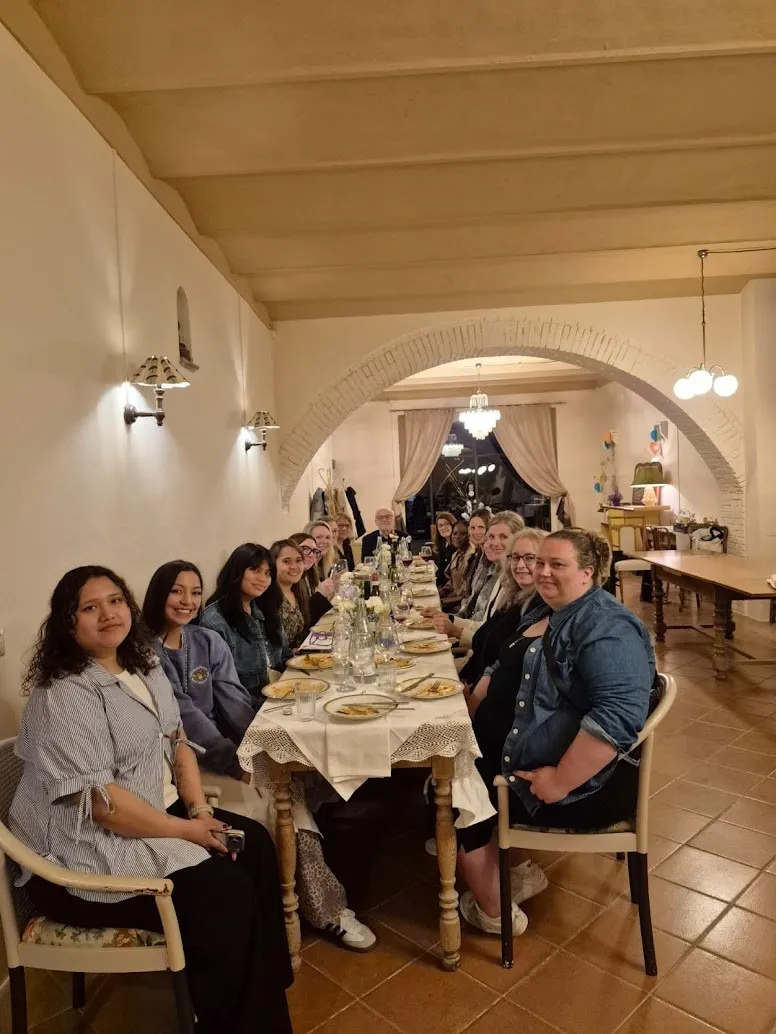
As students shared meals, Italian language lessons, cultural excursions and informal conversations, many of them began to see themselves as well as children differently.
“I learned to slow down, listen deeply, and see every child as full of strength, ideas, and endless possibilities,” says Iya Hall. “Because every child matters, and every voice matters.”
That shift translated into growing confidence and advocacy.
“Through this experience, I feel more confident to advocate for children,” Elvie Lou Labajo shares.
Lori Gray Toma notes that many of the most meaningful moments emerged outside traditional learning spaces.
“Some of the most powerful shifts happened after shared cultural moments, in spaces where students slowed down and really connected with how they were feeling about their learning,” she shares.
Learning as Community
In addition to supporting student learning, the trip also contributed to a faculty-led research project focused on how short-term, experiential international learning influences educator identity. Students were invited to reflect daily through journaling, audio recordings or photos to capture how their perspectives evolved during the experience.
“Experiential education is key to transformational learning,” says Lori, who is leading the research. “We wanted to understand how these kinds of experiences shift how students see themselves as early childhood educators and as advocates.”
Over the course of the trip, student well-being remained central. Faculty checked in regularly, ensuring students felt supported, grounded and able to reflect, even while balancing travel, learning and final-term academic responsibilities.
“We really wanted to make sure that the students’ well-being was number one,” says Henna. “Travelling abroad can be overwhelming, so being attentive and supportive was essential.”
By the end of the week, a strong sense of community had formed.
“What really stood out was the sense of collectiveness,” Lori shares. “We felt like one big family, learning together, reflecting together, and building relationships that grew stronger over the course of the trip.”
Looking Ahead
This inaugural ECED study abroad experience reflects Bow Valley College’s commitment to bringing students into global contexts while grounding them in strong, values-based learning.
Henna and Lori hope the success of this trip will pave the way for future global opportunities, expanding where and how Bow Valley College students learn.
For students like Trudy, the experience will remain deeply personal.
“Exploring the picturesque streets of Italy, tasting authentic cuisine, and engaging with locals truly enriched my learning. The memories and lessons from this trip will forever hold a special place in my heart.”





%201%20(2).jpg)