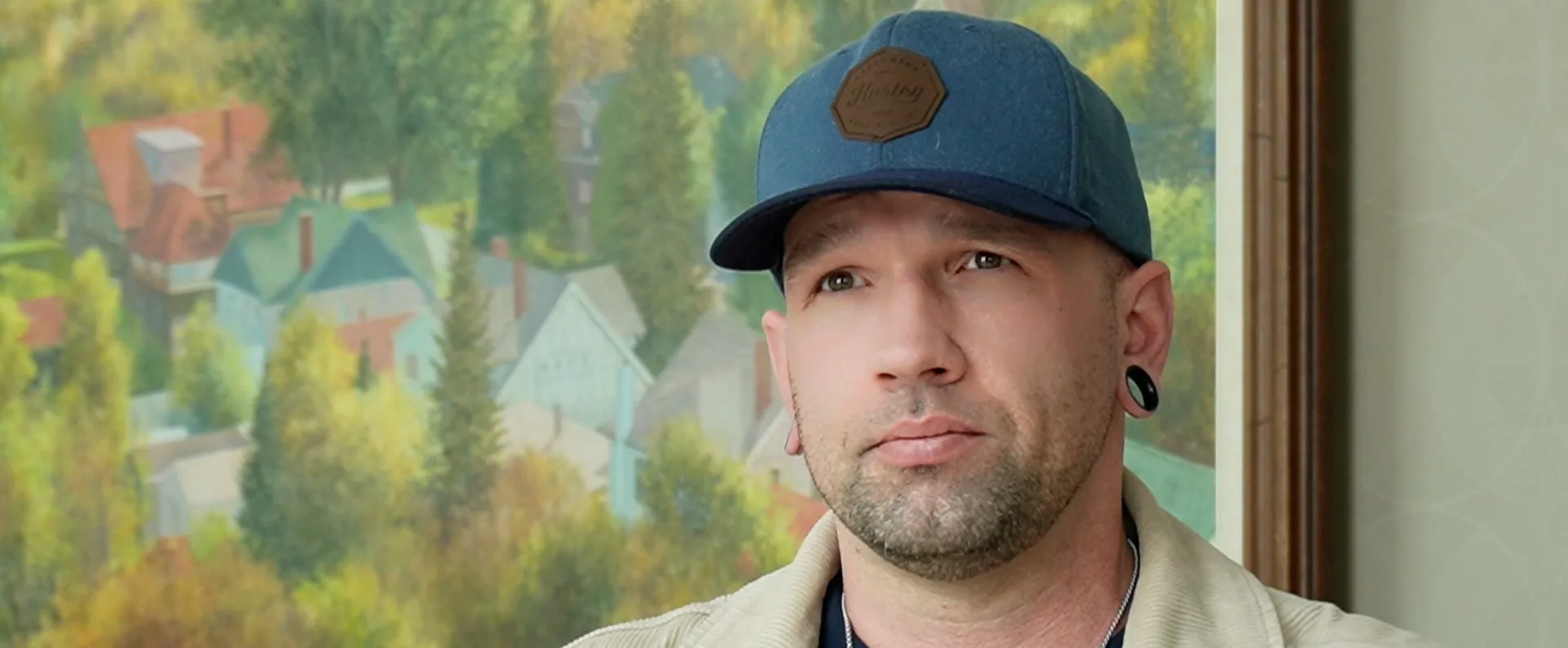

The moment Jared Baker realized he could no longer rely on his body to earn a living, everything changed.
Years earlier, he had been violently assaulted while unconscious, suffering a traumatic brain injury that would alter the rhythms of his daily life. The aftermath was disorienting, including struggles with focus, memory, sleep, and emotional regulation. Leaning on his strength and toughness, Jared tried to push through it. “I went back to work too quickly,” he recalls. Working around nail guns and heavy machinery, he began feeling dizzy and easily fatigued. “That was probably the most unsafe place for me to be.”
Not long after, he learned he also had a heart defect.
Jared had spent more than a decade doing physically demanding work like moving furniture and doing construction. Physical strength had always been part of his identity. But suddenly, it wasn’t an option. “If you can’t pick it up sixteen times, don’t touch it,” he remembers thinking. “I knew I was going to have to pivot.”
That pivot became the path to something more meaningful.
At the same time as his health challenges, Jared was in recovery after having battled addiction since he was in his teens. Reflecting on where he was and where he wanted to go, the idea of returning to school kept bubbling to the surface, even after he had tried to a few years before. “I’d always wanted to go back,” he says. “And I thought, what better way to spend my time than to pay it forward?”
When he came across information online about the Addiction Studies Diploma at Bow Valley College, it felt like it was meant to be. The program offered a way to combine lived experience with education and purpose-driven work.
Returning to the classroom was not easy. Jared was 36 years old, and years removed from any previous schooling. Maybe most significantly, the cognitive effects of his brain injury meant that focus and articulation didn’t always come as easily as they had before. “I could be mid-sentence and completely forget what I was talking about,” he says. Still, school became the space where Jared could rebuild those skills, and another kind of strength.
“There’s no growth in comfort. Pushing yourself is the best way to grow.”
That willingness to sit with discomfort has shaped how Jared shows up in class. He is consistently engaged, asking questions, drawing connections, and reflecting openly. Bryan Flack, one of his instructors in the Addictions Studies program, describes him as “the kind of student who brings both presence and purpose into the classroom.” Bryan observes that Jared routinely links theory to real life and reflects not only on course material, but on his own growth as a future professional.
Jared’s lived experience adds depth to classroom conversations about addiction, recovery, and resilience. “He shares in a way that’s respectful and intentional,” Bryan explains. “In doing so, he creates space for honest dialogue and helps foster an environment rooted in empathy and trust.”
Learning and Beyond the Textbook
The Addictions Studies program has also challenged Jared in unexpected ways. Early on, he was struck by the depth in which Indigenous history, colonization, intergenerational trauma, and systemic inequities were introduced. “It made me realize I had biases I didn’t even know I had,” he says. “That awareness is huge if you actually want to help people.”
Bryan also notes that Jared demonstrates a steady, quiet leadership in class. “He leads through consistency,” he says. “It’s the way he shows up for others, by setting a tone that blends compassion with professionalism.” For Bryan, Jared represents what success in Addictions Studies truly looks like. It’s not just academic achievement. It’s about self-awareness that is couched in humility. It includes a genuine commitment to supporting others.”
The curriculum in the program can be emotionally taxing. Courses addressing suicide prevention and trauma have been heavy. “It’s going to hit a nerve for anybody,” Jared says, noting that he is learning how to care for himself as much as he plans to care for others. “A healthy support system is everything,” he adds, pointing to trusted people in his life, time outdoors, and supports like Recovery on Campus and peer groups at Bow Valley College that create connection and safety.
One moment, however, stands apart.
During a phone call with his grandmother who now lives with dementia, she spoke fondly about the person she believes him to be. The conversation stayed with him. “I decided I’m going to be the person my grandma thinks I am,” Jared shares. That quiet realization has become a compass that continues to guide his choices.
Looking ahead to life after graduation, Jared hopes to work with young people, helping them understand that mistakes don’t define them. “It’s okay to not be okay,” he says. “And it’s even more okay to ask for help.” He wants to challenge harmful narratives around masculinity, mental health, and addiction – and to help create spaces where people feel safe being themselves.
Now in his second term in the program and preparing for practicum, Jared is eager to step into the field. His instructor, Bryan Flack, puts it this way: “He represents the kind of practitioner our communities need.”



%20(1).jpg)

.webp)
.webp)